Having a digital presence today means much more than opening new channels, launching campaigns, or adopting new tools. As a company grows, coordinating teams, processes, technology, and decisions around a unified strategy becomes increasingly complex.
That is often when warning signs begin to appear: initiatives fail to progress as expected, valuable information goes unused, teams work in silos, or projects deliver results for a while but prove difficult to scale.
When this happens, the answer is not always to change a campaign, invest in another platform, or launch a new initiative. Sometimes, it is worth taking a step back and asking a more fundamental question: how prepared is the organization to keep evolving in an increasingly digital business environment?
At MCK Strategy, we use digital maturity assessments as a starting point for identifying structural gaps before defining new media, technology, or MarTech initiatives.
In this article, we'll explore how a digital maturity matrix works, which capabilities it should assess, and why this type of evaluation can help organizations make more informed decisions.
At the end, you can explore and download the MCK Digital Maturity Matrix, available in our resources section. Use it to identify your organization's current stage of development and the capabilities it needs to strengthen to move forward.
What Is a Digital Maturity Matrix?
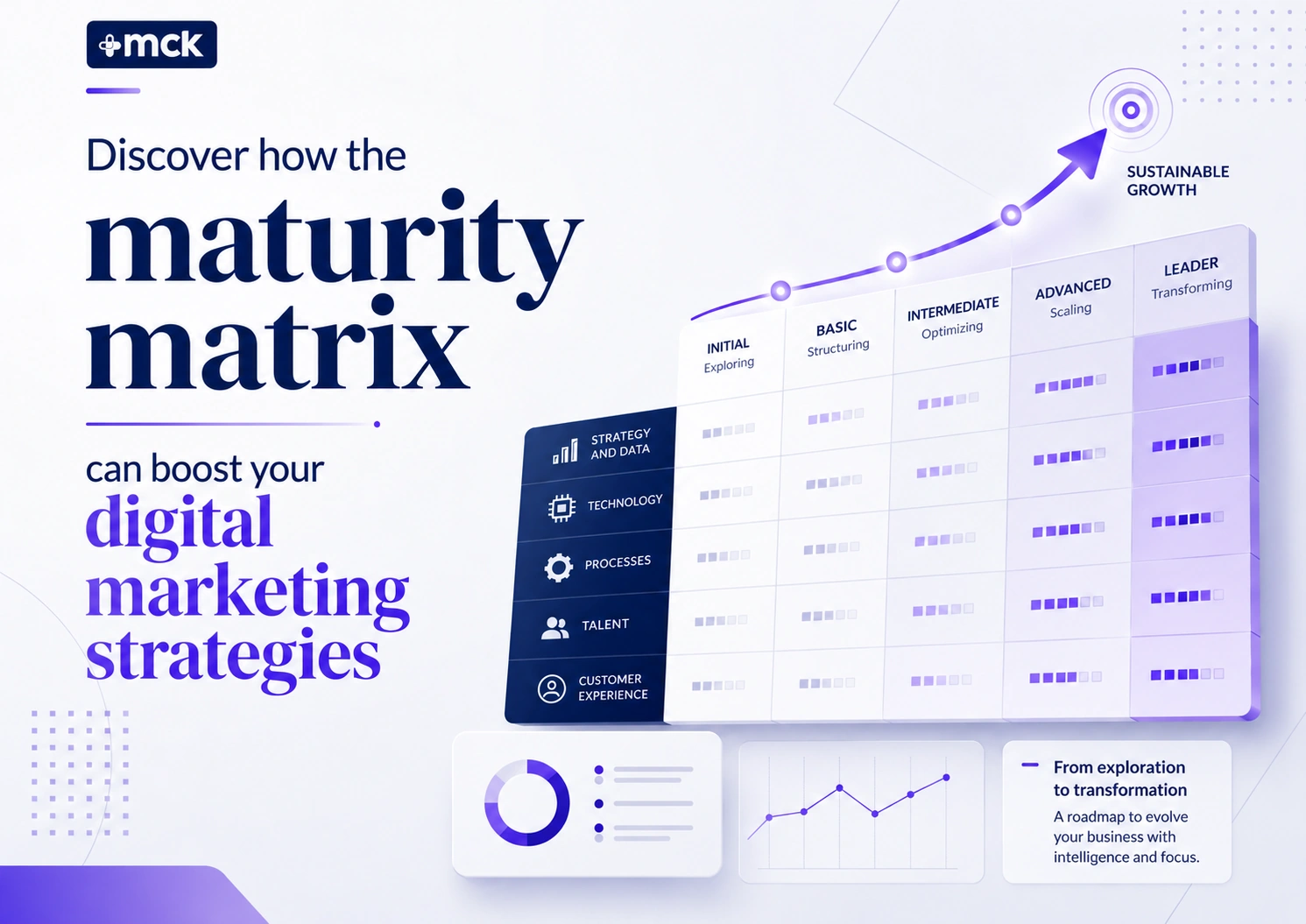
A digital maturity matrix is an assessment framework that evaluates an organization's current digital capabilities and places them along different stages of development.
It provides a snapshot of where the company stands today. However, it goes beyond counting how many digital channels a brand uses, how much it spends on advertising, or which technology platforms it has adopted.
A comprehensive assessment also examines how strategy, data, technology, processes, and people work together. This distinction matters because digitizing processes is not the same as achieving digital maturity.
A company may use numerous platforms and still operate in silos. Another organization with a smaller technology ecosystem may have much better-integrated processes, data, and business objectives.
The matrix helps identify these differences and understand what they mean for the organization's ability to grow.
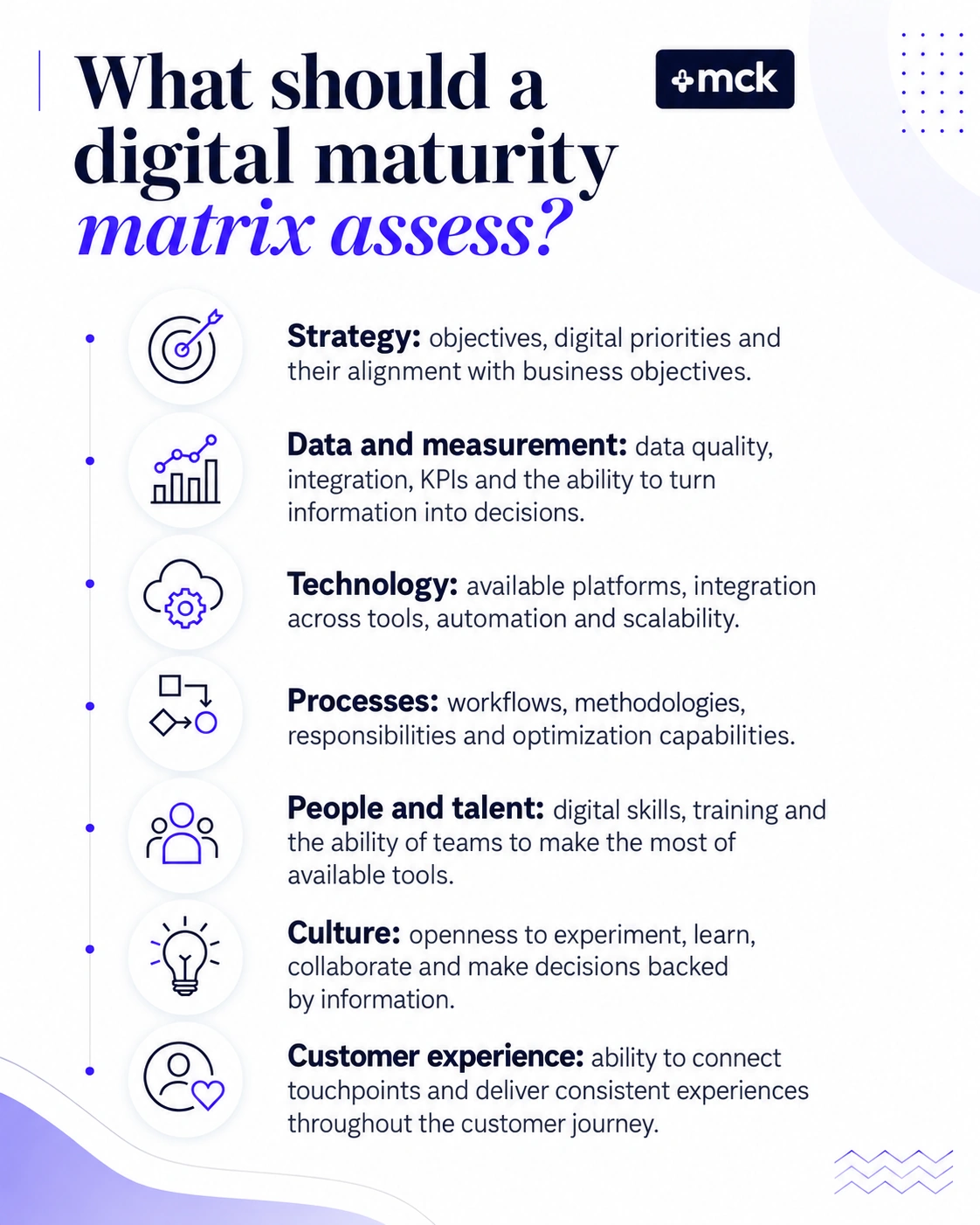
What Should a Digital Maturity Matrix Assess?
A digital maturity model should reflect each company's context, objectives, and organizational characteristics. There is no single matrix that applies in exactly the same way to every business.
Still, several dimensions help build a more complete picture of an organization's digital capabilities:
- Strategy: Business objectives, digital priorities, and how they align with the company's overall goals.
- Data and measurement: Data quality, integration, KPIs, and the ability to turn information into actionable decisions.
- Technology: Available platforms, integration between tools, automation, and scalability.
- Processes: Workflows, methodologies, responsibilities, and the ability to optimize operations.
- People and talent: Digital skills, training, and teams' ability to make effective use of available tools.
- Culture: Openness to experimentation, continuous learning, collaboration, and data-informed decision-making.
- Customer experience: The ability to connect touchpoints and deliver consistent experiences throughout the customer journey.
Assessing these dimensions helps prevent one of the most common mistakes: measuring digital maturity based on technology alone.
The tools matter, but so do the people using them, the information they work with, the objectives behind their implementation, and how they fit into the broader operation.
How Does a Digital Maturity Matrix Work?
The process begins by defining the dimensions to be assessed and the criteria used to distinguish between different stages of development.
The names and number of stages vary depending on the methodology. For example, an organization might progress through four stages: initial, developing, integrated, and optimized.
However, the goal is not simply to assign the company a maturity level. The real value comes from understanding why the organization is at that stage and what needs to change for it to progress.
Consider a company that collects information through paid media campaigns, its CRM, e-commerce platform, and social media channels. At first glance, it appears to have a robust digital ecosystem.
But the assessment reveals that each platform operates independently, teams produce separate reports, and there is no integrated view of the customer journey.
The company has invested in technology, but it still has gaps in data integration and strategic use. The matrix makes these issues visible and turns them into specific areas for improvement.
How Can a Digital Maturity Matrix Improve Your Marketing Strategy?
A digital maturity matrix helps distinguish tactical challenges from structural problems.
Imagine a campaign starts losing efficiency. The immediate response might be to change its target audiences, creative assets, budget, or advertising platforms.
However, the assessment could reveal that the underlying issue is somewhere else: incomplete data, unreliable measurement, limited coordination between marketing and sales, or processes that are too slow to turn insights into action.
The matrix changes the question. Instead of asking only, "What should we change in this campaign?", the organization can start asking, "What capabilities do we need to develop to execute our strategies more effectively?"
That shift makes it possible to address root causes rather than simply treating symptoms.
What Changes After You Assess Your Company's Digital Maturity?
The results of a digital maturity assessment should lead to a prioritized roadmap.
Not every gap needs to be addressed at once, and not every improvement will have the same impact on the business. After the assessment, organizations should identify which capabilities are essential to move forward and which can be developed later.
For example, a company might discover that it needs to:
- Integrate its data sources before implementing more advanced attribution models.
- Define KPIs that reflect actual business outcomes.
- Align marketing and sales around a shared process.
- Automate repetitive tasks.
- Strengthen the team's analytical capabilities.
- Establish clear ownership and responsibilities for each platform.
- Build consistent processes for experimentation and optimization.
This is how a digital maturity matrix becomes more than a classification tool. It becomes a framework for deciding where to invest time, talent, and budget.
Does Greater Investment Mean Greater Digital Maturity?
Not necessarily. An organization does not become more digitally mature simply by adopting more technology, opening new channels, or increasing its marketing budget.
The goal is to develop the capabilities needed to coordinate those resources and turn them into meaningful business outcomes.
For example, implementing a new marketing automation platform may deliver little value if the underlying data is fragmented or the team lacks the processes to make effective use of the information it generates.
Before adding more tools, it is worth understanding which business problem they are expected to solve.
Digital maturity is not about accumulating technology. It is about developing the capabilities to learn, execute, and optimize with greater speed and precision.
Does the Same Digital Maturity Matrix Work for Every Business?
A digital maturity matrix must adapt to the context of each organization. A B2B company with sales cycles that last several months should not assess exactly the same capabilities as an e-commerce business handling thousands of transactions every day.
Likewise, a company just beginning to organize its digital measurement processes will have different needs from one already using automation, advanced data models, and personalization.
Industry, business model, company size, customer journey, technology infrastructure, and commercial objectives all influence what a particular maturity level means.
The goal should not be to reach the highest level on a matrix for its own sake. It should be to develop the digital capabilities the business actually needs.
Digital maturity is a continuous process, not a destination.
Why Should You Reassess Your Company's Digital Maturity Over Time?
Digital channels change, new technologies emerge, consumer behaviors evolve, and organizations continue to develop new capabilities. That is why digital maturity assessments should be revisited periodically to measure progress, identify new gaps, and adjust priorities.
This approach turns digital maturity into an ongoing cycle of assessment, implementation, measurement, and optimization. It also provides a different perspective on business strategy.
When results fall short of expectations, the answer is not always to change a campaign or introduce another tool. Sometimes, the next step is to identify which organizational capabilities need to improve so the broader strategy can perform more effectively.
Assess Your Company's Digital Maturity with MCK
An assessment is only the starting point. Its real value lies in identifying which gaps are holding back growth and which ones should be addressed first.
A digital maturity matrix helps structure that conversation. The goal is not to achieve a perfect score, but to understand whether the organization needs to strengthen its processes, integrate data more effectively, develop internal capabilities, optimize its media ecosystem, or better connect technology investments with business objectives.
From there, the challenge is to turn those findings into a clear, prioritized, and measurable action plan.
At MCK, our MCK Strategy team helps organizations make that transition. We start by understanding the business, its audiences, and its digital assets to define strategic priorities, media architecture, and growth initiatives aligned with actual business objectives.
Through our growth consulting approach, we help companies determine what needs to be addressed before launching new campaigns or increasing their investment.
To understand where your organization stands today, explore the MCK Digital Maturity Matrix. This resource helps assess different stages of digital development and examine capabilities related to business, people, and media.
If your assessment has already revealed what needs to change, the next step is to turn those gaps into a strategy.
MCK Strategy can help you prioritize initiatives, connect business objectives with audiences and media, and build a growth roadmap that can be measured and optimized over time.
Let's get results together.