The best TikTok content formats are not necessarily the ones that rack up the most views. They are the ones that connect audience behavior with a clear business objective.
The right format depends on its role in the customer journey and on the brand’s ability to turn attention into meaningful growth signals.
Choosing the right format takes more than jumping on viral sounds. TikTok trend analysis highlights the value of unfiltered stories, real processes, and behind-the-scenes moments over content that feels overly polished.
At MCK Agency, we approach TikTok as an official platform partner, combining strategy, platform-native creative, and performance marketing to help brands identify the formats best suited to their goals and determine how to measure their impact in campaigns.
For brands, the challenge is not simply to create content for TikTok. It is to speak the platform’s language without losing strategic clarity, creative consistency, or the ability to measure results.
This guide explores the TikTok content formats that serve different marketing objectives and explains how to choose the right ones for reach, consideration, community building, and conversion.
What Makes a TikTok Content Format Effective?
A TikTok content format works when it feels native to the platform, delivers value within the first few seconds, and encourages an action aligned with the campaign objective.
TikTok’s Creative Codes recommend a structure built around a strong opening hook, a compelling middle, and a clear ending. Key creative elements include vertical video, on-screen text, voiceovers, creators, and fast-paced editing.
That does not mean creating content without a plan. An effective TikTok content strategy starts with a hypothesis for every asset: which audience it should reach, what problem it addresses, what signals indicate engagement, and what business outcome it should support.
Before choosing a format, our Strategy team helps define TikTok’s role within the brand ecosystem, identify high-potential audiences, and establish the KPIs that should guide execution.
Production should begin only after the role of the content has been clearly defined.
What Are the Best TikTok Content Formats for Brands?
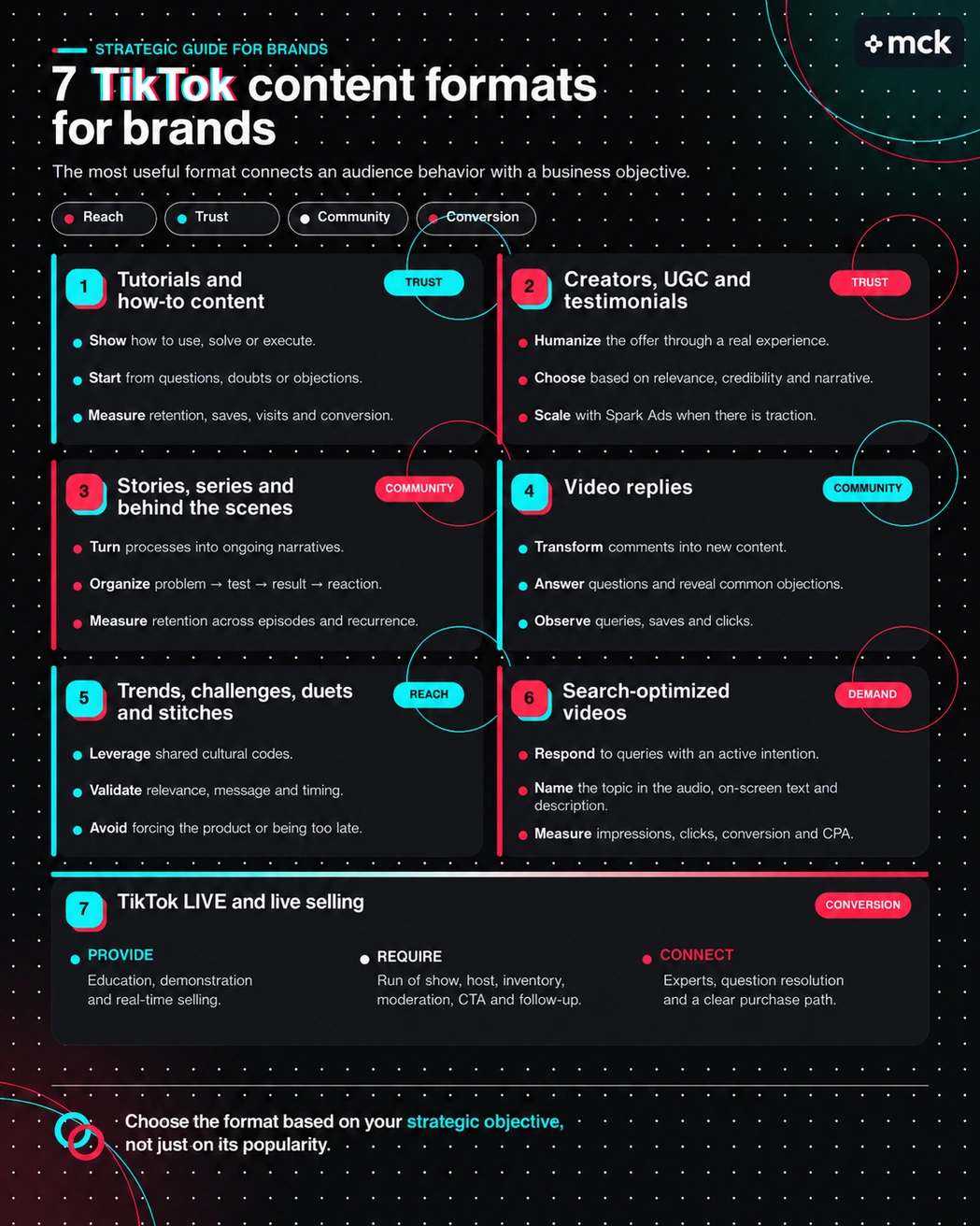
Some of the most strategically valuable TikTok content formats include tutorials, creator content, episodic storytelling, video replies to comments, trends, search-driven videos, and livestreams. Their effectiveness depends on the objective: reach, trust, community engagement, or conversion.
1. Tutorials, Product Demos, and Educational Content
Tutorials show audiences how to use a product, solve a problem, or complete a task. They work because they deliver value before asking viewers to take action, allowing them to assess the benefits, complexity, and real-world applications of a product or service.
Start with search queries, sales objections, or questions frequently raised with customer support.
The key is to demonstrate the product in action rather than simply describe its features. Useful performance metrics include watch time, video completion rate, saves, product page visits, and assisted conversions.
2. Creator Content, UGC, and Testimonials
User-generated content (UGC) and creator partnerships bring a human perspective that traditional corporate messaging often struggles to replicate.
These formats work best when creators demonstrate, interpret, or test a product or service through their own experiences rather than simply reciting an advertising script. Brands should select creators based on audience alignment, subject-matter credibility, and storytelling ability—not just follower count.
Clear guidelines are also essential for advertising claims, product usage, and sponsorship disclosures. The goal is to meet commercial and compliance requirements without losing the natural style that makes creator content effective on TikTok.
When a strategy calls for a consistent stream of these assets, MCK Productions turns strategic direction into platform-native creative.
The team specializes in UGC, product reels, and branded video production, helping brands maintain TikTok’s distinctive style while ensuring creative consistency and alignment with commercial objectives.
An organic post that performs well can also become a paid media asset. Spark Ads allow brands to promote existing organic posts as ads while retaining the engagement associated with the original content. This makes it easier to test which creative concepts have the potential to scale through paid media.
Creator partnerships and UGC are therefore more than tools for building authenticity. They can form a continuous cycle of production, learning, and amplification, in which top-performing assets inform future content and media decisions.
3. Storytelling, Series, and Behind-the-Scenes Content
Short-form storytelling turns brand processes, people, and decisions into narratives that capture attention and build brand recognition. A series can develop an idea across multiple videos—for example, introducing a problem, showing a test, revealing the outcome, and sharing the reaction—to encourage viewers to follow along.
Behind-the-scenes content is particularly useful for showcasing manufacturing, design, service preparation, lessons learned, or the people behind a brand. Its value lies not in pretending to be spontaneous, but in revealing information that a conventional ad would not normally provide.
Measure performance through audience retention across episodes, profile visits, follower growth, and returning viewers.
4. Video Replies to Comments
Video replies turn community questions into a source of ongoing content ideas. TikTok allows creators and brands to respond to a comment with a new video, providing additional context and opening the door to further discussion.
This format can address questions, clarify misconceptions, explore a product in greater depth, or continue an existing series. It also provides a form of qualitative audience research: the frequency and wording of questions can reveal objections, interests, and opportunities for new content.
Prioritize representative comments, avoid exchanges that expose personal information, and track which replies generate follow-up questions, saves, or clicks.
5. TikTok Trends, Challenges, Duets, and Stitches
Trends are shared storytelling conventions that emerge within the TikTok community. They include sounds, memes, challenges, effects, Duets (side-by-side video responses), and Stitches (clips incorporated into a new video).
These formats create opportunities when a shared cultural reference helps a brand communicate something distinctive about itself.
Before joining a trend, evaluate three factors: audience fit, relevance to the brand message, and whether the trend will still be timely when the content is published.
Forcing a product into an unrelated trend can generate visibility without building brand recall—or result in content that feels late to the conversation.
TikTok Creative Center helps marketers track trends by region, but the final decision should always reflect the brand’s positioning and campaign objectives.
6. TikTok Videos Optimized for Search
TikTok is also a platform for intentional discovery. Search-driven videos answer specific queries through explanations, comparisons, lists, and product demonstrations.
Clearly communicate the topic through spoken audio, on-screen text, the video caption, and the conversation itself, without keyword stuffing.
The same principle applies to organic and paid content. TikTok’s Search Ads Campaign supports video and image carousel assets associated with keyword themes.
For brands, this creates an opportunity to connect useful content with stronger signals of audience intent. Relevant metrics include search impressions, clicks, search queries triggered, conversion rate, and cost per acquisition (CPA).
7. TikTok LIVE and Live Shopping
TikTok LIVE enables brands to demonstrate products, answer questions, and present offers in real time. It is most effective when the livestream has a clearly defined purpose: educating, launching a product, advising customers, entertaining viewers, or driving sales.
Unlike prerecorded videos, livestreams require content, production, moderation, audience engagement, and conversion efforts to work together in real time. A live shopping strategy therefore needs a clear run of show, prepared hosts, product demonstrations, verified inventory, calls to action, and post-stream follow-up.
As an official TikTok partner, MCK Agency can integrate these activations into a broader content and performance marketing strategy, connecting the livestream experience with each brand’s business objectives, target audiences, and commercial opportunities.
Our experience also extends beyond TikTok to other livestream commerce formats, including our Devlyn e-commerce livestream case study.
In that project, subject-matter experts, real-time answers to customer questions, and a clear path to purchase helped turn a livestream into a commerce-driven experience rather than simply an online broadcast.
How to Choose the Right TikTok Content Format for Your Goals
Choosing the right TikTok content format starts with defining the change you want to create in your audience and the business outcome the content should support.
The right format is one whose viewing behavior, participation mechanics, and measurement approach align with a specific objective.
Before production begins, consider three variables together: the stage of the customer journey, the audience behavior you want to encourage, and the KPI that will define success.
A reach-focused format should capture attention and encourage distribution. A consideration-focused format should provide evidence and address objections. A conversion-focused format should reduce friction and encourage action.
- Reach and cultural relevance: Trends, creators, Duets, and Stitches.
- Consideration and trust: Tutorials, product demos, testimonials, and behind-the-scenes content.
- Community engagement and learning: Video replies to comments, series, and TikTok LIVE.
- Demand generation and conversion: Search-driven content, Spark Ads, product demos, and live shopping.
These are not rigid categories. A tutorial might start as an organic post, develop into a series, and then be amplified with Spark Ads if it delivers strong results.
However, a single post should not be expected to build reach, explain an offer, drive conversions, and foster loyalty all at once.
The strategy should work as a system: identify a question or need, select the most suitable format, measure the response, and scale the creative executions that generate the most meaningful business results.
When an organic post is ready for paid amplification, MCK TikTok for Performance connects creative formats with audience targeting, media investment, and campaign optimization.
As an official TikTok partner, MCK runs acquisition- and revenue-focused campaigns, tracking KPIs such as CPA, return on ad spend (ROAS), and click-through rate (CTR) to determine which creative executions should be scaled.
How MCK Turns TikTok Content Formats into Business Results
At MCK Agency, an official TikTok partner, we approach the platform with business outcomes in mind.
Through TikTok for Performance, we connect creative formats, audiences, paid media, and KPIs to identify which executions can drive customer acquisition, consideration, and sales.
Creative development is also an essential part of performance marketing. Through MCK Productions, we develop UGC, vertical video content, branded productions, and AI-assisted creative tailored to TikTok and each campaign’s objectives.
Our experience with livestream commerce also helps us apply valuable learnings to TikTok LIVE activations.
The goal is not simply to produce more content. It is to identify what works, learn from campaign performance, and scale the formats that contribute to business growth.
If your brand wants to make better use of TikTok, a strategic consultation can help identify opportunities, select the right formats, and define growth priorities.
Explore MCK TikTok for Performance.
Let’s get results together.
Frequently Asked Questions About TikTok Content and Performance
1. What Is the Difference Between an In-Feed Ad and a Spark Ad on TikTok?
Spark Ads are native ads that use existing organic posts published by a brand or creator. A standard, non-Spark In-Feed Ad uses creative uploaded directly through TikTok Ads Manager.
With Spark Ads, engagement generated during promotion—including views, comments, shares, likes, and new followers—is attributed to the original organic post.
This makes Spark Ads particularly useful when an organic post is already performing well and a brand wants to amplify it through paid media without losing its social context.
2. How Long Should a TikTok Video Be to Perform Well?
There is no single ideal video length for every TikTok content format. TikTok recommends presenting the value proposition within the first three seconds and establishing a compelling hook within the first six seconds to capture attention.
For many performance ads, the platform uses videos of approximately 21 to 34 seconds as a creative reference, although the appropriate length depends on the message and campaign objective.
Rather than focusing on a fixed duration, test different video lengths and analyze audience retention, completion rates, clicks, and conversions to determine what works best for each audience.
3. How Do You Measure the ROI of a TikTok Content Strategy?
Return on investment (ROI) measures attributable business results against the total investment required to generate them, including production, creators, operations, and paid media. Depending on the objective, additional metrics may include CPA, customer acquisition cost (CAC), conversion rate, revenue, and ROAS.
TikTok supports conversion tracking through tools such as TikTok Pixel and Events API. These tools can record website events such as page visits, add-to-cart actions, and purchases to support campaign measurement and optimization.
It is important to distinguish ROI from ROAS. ROAS compares attributed revenue with advertising spend, while ROI takes a broader view of the costs involved in generating a return.
4. Should Brands Produce UGC or Partner with TikTok Creators?
It depends on the campaign objective. UGC can provide brands with a consistent supply of platform-native creative assets, while creator partnerships also bring a creator’s individual voice, credibility, and relationship with a specific community.
Both approaches can work together. A brand might produce several UGC assets to test hooks and value propositions, partner with creators to explore new creative angles, and then amplify promising posts through Spark Ads.